Sunday, July 19, 2009

videoThis video was shown as an installation in my apartment last summer. The interviews with my grandmothers were recorded by my brother, John, and we played live music during the screenings. The images come mainly from my travels around Germany and Austria, and of my neighborhood here in Berlin, supplemented with found footage and super-8 from the archive of my friend, Susanne Sachsse.

The idea was to show my neighborhood, which is largely populated with immigrants as a place where home is both here and elsewhere. The stories of two older women whose families had migrated from Europe are set next to their grandsons who, two generations later had migrated back. We played live music from the kitchen as the spectators watched the film on a bed in the main room. The audience came two at a time, five hours a day for five days.

Dorothy is the name of my mother’s mother.


This was right before I went back to my hometown to see her again before she was too sick to have company. It had been over 20 years since I had spent time with her.


The fact I had been away for so many years dissolved almost instantly in the couple of weeks we spent time together, and I was in the company again of my grandmother, like when she would teach me about planting tulips, and how to get different colors by breeding the bulbs. She harvested sacks of them after they had bloomed, and stored them for the next year. I still treasure the times I would go next door to her house to have some quiet time, sometimes just sitting on her couch, looking at things in the room and listening to her make me a lunch that I ate with her. She would chat away and I would ask her questions.


She always seemed so glamorous to me because she seemed at ease in the world, comfortable moving in a world that seemed so confusing to me, like the whole thing was somehow her idea.


This summer she would have trouble sleeping at night and often when I came downstairs she was pottering away in her room, and we would just chat about some TV show, or the election, or animals. One morning we had a few hours before she had some appointment and I asked her if she wanted to drive up to the Vista House with me. She slept all the way there, and when we were up the overlooking the gorge, I could not help but notice that although she seemed so small, I seemed even smaller, and I could not tell if it was because I was feeling like I had done wrong in suggesting the trip.


We looked over the cliffs, it was sunny and the canyon made both of us seem small. We talked about going to Rooster Rock together when I was a boy, about her experiences when she was a young woman, her loves and troubles, and of how things find a way, somehow. Driving back down the scenic highway I know why I seemed small again in her company. Time had vanished, and somehow I was six, or eight again, and I was with her.   

Thursday, May 28, 2009

video
The process of this video began when I noticed the cable connecting the TV to the VCR was damaged. By manually shaking the cable while using the remote to the VCR to fast forward, reverse or pause I got some amazing results on the screen. I set up the video camera and recorded the television, then took stills from the tape and brought out more of the color that was already there. Then the stills were imported to the film and animated. The sound was a record by Earth, Wind and Fire which I played manually. What was strange was at some point in playing quickly backwards and forwards the voice seemed to say, "Terrorists will be....." Please forgive the poor resolution.

Monday, May 11, 2009

from February issue of Film Ireland ed. Paul Rowley/Nicky Gogan


Happiness for One Day

The frame of film here was exposed in late summer of 1997, but did not find its way into this film until nearly ten years later. It was exposed by a man holding a motion camera for the first time, and who was leaving the rather hermetic activity of writing in favor of the more social activity of making films. His first attempt failed to capture the intensity of its subject. He did not understand the Image, and how it functioned. Many years later after much experimenting and watching films he came to understand the function of the Image closely followed what he understood the great quest of the Alchemists was; transformation of everything. The self, the world, its lands and peoples here changed through light and motion. He set to re-editing the footage, and what you see here is an image of happiness felt and exposed to the sun on the hills of the Altamont Pass.

pictured is Heidi Follin

Saturday, May 9, 2009

Shadow film 3

SHARDS

The Street lay out before him, an obsidian plane broken by thousands of shards of light. He could see by the frequency of their blinking that the street was busier halfway up the block. Passerby walking bunched and bustled around unseen obstacles, thereby blocking the sun’s light on to the bits of broken glass and sharp, metal fragments that shimmered in the sunlight. At this point these stars on the ground blinking were all he could see. Garret could tell by the warmth on his neck that he was on the sunny side of the street, and that his chances of being guided by these reflections was greater here, and that with luck  a car might pass, or even better, he may come across a shop with a long window that caught the sun’s light.


Garret’s sister had told Jay at a cafĂ© last week that he had come back. She told him that Garret had been discharged before his tour was finished because of some medical or psychological reason related to an explosion that had killed three fellow soldiers and left Garret blind. Garret had taken Jay’s heart when he enlisted . For two years prior to his departure, Jay had felt for a little bit every day the quiet and secure joy of knowing he was loved. The unexpected ferocity of emotion between both of them when Garret told him he was leaving for Iraq had reduced Jay to a burnt husk whose cinders drifted until he was lo longer.


The hostility to their love existed before them, waiting in the very air they breathed to someday sacrifice them. So it was without discussion that that love was kept in shadow. Being both from religious parents-- Garret’s father was the pastor of a small but aggressive congregation whose flock balanced the hopelessness of their impoverished lot against an army of invisible enemies; homosexuals, health workers, on down to the most petty of government bureaucrats, none of whom any of them had met, while Jay’s unmarried mother had constructed her threadbare respectability by compulsively sharing her experiences as a born again reformed drug addict and prostitute to the amusement, horror and sense of righteousness of that congregation into which she would never fully belong by virtue of her 17 year old, illegitimate son, Jay.


With a loan secured from his father, Garret had secured his first apartment, and it was between those walls that he and jay experienced the riot of senses and emotions of which new love is comprised. Jay would visit the small, one room apartment after school under the auspices of having Garret, a former student and team-mate from his school tutor him. Lying in their bed, in the shadow of the dark apartment, Garret would watch Jay through the bathroom mirror as he prepared to leave, and think of an inverse world that existed just behind the polished surface of glass. This world, he imagined was one where himself and Jay would walk untroubled. He found it surprising that reflections stay so close to the surface and border of the world they reflect, and that they do not simply walk deeper into the reflection and happily vanish.


Within the smaller circles of people of an already small town the need for enemies, whether real or imagined soon laid siege upon the young lovers. That the Pastor’s son, a promising, handsome graduate at the top oh his high school class would settle for a job at the local video store, spending all of his free time with the bastard son of a former prostitute soon appeared to the town like a wart, and a cloud of fear began to eclipse their formerly carefree afternoons together. It was even rumored that a note with an undercurrent of violence is what lead Jay to halt his afternoon tutoring lessons. It was a larger and more diffuse threat of violence in search of an invisible enemy that provided Garret a reason to vanish, which he took advantage of by enlisting in the army and going to Iraq.


It was under a sun so total, so complete that it cast no shadow where the landmine exploded. By eliminating all shade it was if the sun demanded witness to these atrocities. In the hospital under the bandages Garret saw only blackness. When he had sufficiently healed and the headwraps removed he saw only shards and scraps of light, in which he hoped to see the reflection of Jay.


Jay had been watching Garret walking down the street, one arm out, seemingly feeling the air for something invisible, the other tapping a cane as he pursued his fragments of light. He followed at a safe distance, slowly gaining confidence in his invisibility until moving up close behind Garret. He did not know if he would say anything. The light had turned red and Garret was about to step into the street when for in instant he thought he say Jay’s face in the passing reflection of a car window. The moment all went black again he felt a hand on his arm from a stranger who held him from harm. 

Monday, May 4, 2009

video

Sunday, May 3, 2009

Shadow film 2


Shade Released

The bus stood still at the corner of McAllister and Lyon for the duration of three light changes before the lack of motion stirred him from his thoughts. The Bus driver had stepped off the bus, being ahead of schedule and needing some cigarettes from the liquor store. So he grabbed his things and decided to walk the last three blocks home.

This intersection was where a year before he had been thrown up against the rusty, metal grating that protected the window of the store before being handcuffed and put into the back of the patrol car. It was about the same time of night, and as he cast a glance at the store, he was too tired to think of that any more, and he started home.  For fifteen years he had lived on this street and knew it and many of its inhabitants well. One corner up was the lazily named McBaker market, run by Mohammed, whose three sons he had seen grow from boys to young men. A Christmas poinsettia planted in front of a faded and chipped Victorian to his right had by now grown into a tree whose rich, red colored blossoms pierced anything that would block light, be it night or fog. One block up was a sad and empty storefront not rented since the very nice man with a shy son had been shot and killed in a robbery. He had heard this shot while he was watching the evening news. The neighborhood drunk who went to Antigua every few years to sober up still stopped to make talk, whether drunk or sober, using the street like a living room. For the first block these were his thoughts.

After crossing the intersection of Baker and McAllister his reverie looked home. Clay, who he had first encountered hand painting the leaves of the tree in the front in metallic gold, once lived in the storefront at the base of his building with his boyfriend Curtis. He had become fast friends with Clay and took to having long conversations and coffee together on Saturdays. Jude lived in the flat above that. He bred designer fish in a laboratory he built in the glassed in back porch. In fact it was with Jude he was arrested the year before when the cops mistakenly thought the long talk the had together on the street that warm night was in fact a drug deal. Jude fought injustice instinctually without pride, and the two of them had been in courthouses together more than once, mostly losing. Cleo lived in the tiny basement apartment behind Clay and Curtis, and though she kept mostly to herself, she would always join the others in the building in the backyard shared by all. This backyard had two plum, one quince, an almond and a eucalyptus tree and it was once a lively place of gardening, cooking and visits from neighbor kids who would hop the fence when they heard all the laughter.

For some years this had been gone. Clay and Curtis had moved to the Mission district, Both Jude and Cleo were evicted in the on going gentrification of the neighborhood. Only he and his roommate remained in the top flat, which had absorbed a certain sadness into its walls. He remembered it was such a rainy night when Jeff had died that his cries were stifled in the downpour as he sat on the back steps. Blue glitter from Jeff still surfaced when he swept the floor all these years later. Dominique had become a victim of her addictions, dampening her acerbic wit and fire like intelligence. Rocco and Malcolm had died years before in the first wave of what was then called “The Gay Cancer”, later AIDS. Darryl had tossed himself from the bridge some time back.

The city in general, the neighborhood and flat in particular were once so full of love and life, he remembered. Walking home this night, an inventory of past loves, pleasures and current losses moved through him, and he watched his shadow pass from back to front under him as he went past the lamps, a single shadow that slid like this before being extinguished again and again. His mind quieted as he focused on this lone shade. At the next lamp two shadows emerged from beneath him. Without panic he knew what was happening. One hand held a gun to his head, while the other wandered his body. He watched these two shadows merge and part in this quick dance, while thinking it would be sad if this were the last thing he saw. It occurred to him to raise his eyes and watch through the reflection of the drug rehabilitation house. What was astonishing is that he never thought he could do this to himself. There was a flash, a deafening ring, and the silky flow of blood down his neck.

Through the reflection in the window he watched his body fall, leaving him standing alone. He had no idea why he had a gun in his hand. Though he was at his flat, he saw a bus coming up from Divisadero. He hurried past the storefront where Curtis and Clay once lived, making it to the bus stop in time. It was going out to the beach where it would be empty and black, both sea and sky, and he would be free of both shadow and reflection.  

Shadow film 1


The Instant Vanishing of One who left a Shade Burned


She sat on the steps of the Savings and Loan where they had agreed to meet. It was a very cold morning and her breath seemed to crystallize upon meeting the morning air. As she waited she held an image of his face in her mind, framing it with imagined garments; a multicolored scarf with bits of yellow that privileged his almond skin, a blue winter coat that showed the brightness of his smile. In fact she had no idea if he owned these things. She had not yet met him.


As he walked to the department store he felt his thoughts loosen and gently fall from him for others to pick up. The war, his mother’s sickness, the complex network of rules for the rationing of food and goods that somehow, though very fragile, contained a logic that had become everyone’s life. All this floated from him as he walked in the brisk afternoon sun. At the store he stood before a mirror, lost in what were not yet thoughts, but more like shadow ideas of this life or that person. To most anyone watching he looked like a man trying on a scarf he had not yet bought, carefully wrapping it around his neck and shoulders.


A welcome intrusion to his reverie was a gaze caught on the surface of the mirror. As if expecting this visitor, his eyes met hers with a smile. He unwound the scarf he could not afford, folded it and put it back on the display table. Turning to look in the direction where she had watched him from he saw that she had gone.


It was half past four when her phone rang. Her heart quickened at the surprise. It was the reflection telling her he had found something of hers at the store, which was how he got her phone number. As his warm voice spoke into the receiver she looked through her handbag. She had indeed dropped her address book shortly after being caught in his eyes. After discussing mutual locations they decided to meet at a bank halfway between their homes the following morning.


She did not sleep well. As she lay on her back in the dark listening to the radio speak quietly about her country’s young heroes, she thought that this is what war was like. It is the same as ever, though slightly different. People still lay awake in the dark, still agree to meet strangers in the morning in front of familiar buildings, still shop for scarves. Only his face broke her meditations on war, on the announcements of pending victory for her country. His face brought peace. Finally with the pale light she rose, feeling a bit foolish as she dressed nicer than the occasion warranted. She locked up the apartment and headed out to meet him.


As he walked down the street he caught his own reflection in the passing window, and he remembered how her gaze in the store mirror the day before had in some way unified what had been broken. The unreality of life in wartime had infected him to the point where he felt unreal. The line of sight in that moment through the reflected surface of polished glass brought a moment’s respite from the power outages, the long lines for provisions, and with the softest touch, from fear.


The sky ripped in half that morning. The heat and wind alone killed eighty three thousand people instantly. Can we even say they died? They simply vanished. To where? She left a shadow behind, burned into the pavement by the heat of the blast. Maybe she let go of her shadow in hope he would someday find her. Thinking of her smile in the mirror he vanished with the light, leaving not shadow or reflection.

Wednesday, April 29, 2009

Properties 1

Social histories, personal memories, the theoretical and the material; a film is what is not there; it is an experience of what is between each element in its whole. One thought is that the detail is the point of exchange between filmmaker and viewer, where a gift is given. If a film is a whole series of relationships then it is the frame, the house of the Image where this detail resides. Indeed, the Image is the detail, the gift through which emotional, practical and political relationships flow.

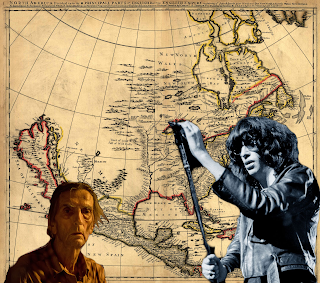
  The image is between time, linking the present to anywhere. The movement of people through time, through the frame, and the frame packed with images for this journey. In this frame a father is at the Pacific coast with his children and dog. This photo is replicated within the frame, and sits on a map of Germany that dates from the time the photo was taken. What you do not see is the movement of the camera’s lens over these objects, or the movement of these replicas, laid out like a hand of cards. The father, dog and Pacific coast are gone, details in a gift of memory. 
The three DVDs here cover much of the work I have done since 2004 in my study of the nature, function and properties of the moving image, a thing which haunts me. 


I suspect the work of the image is the work of ghosts, the dissolving of identities, the merging of the personal and the historical in a common pool of images where everything can be transformed. Us. The world.

Ghost Box contains a majority of short work I have produced in the last few years.

One Poem Less has two longer pieces. One is a reworking of the tale of Scherezade in the context of immigration, the other is a home movie from my trip back to my home town, and is a sort of essay film at the same time.

RE- (fused, mixed and cycled) is a 40 minute music video that is both with the music and the image a remixing of finished works with odds, ends and scraps.

These videos are distributed by the Arsenal Institute for Film and Video Art
information on them can be found here;
http://www.fdk-berlin.de/en/arsenal-experimental/artists/tim-blue.html

or by contacting me at lenaustr25@yahoo.co.uk 

Labor 9

video

Weapons of Leisure

video

Tuesday, April 28, 2009

Data Fragments

video

Notes for a film

In the late 90’s I worked with my friend, Paul Rowley on his first feature film, As Lathair. Paul gave me stacks of notes, and we worked with them back and forth until the final voice overs were ready for recording. I no longer have the final version, but recently found these notes on my computer in a folder called, “old texts”. After ten years, we are working on another collaboration, an expansion and development of a short we made together last summer (2008), and which premiered at the Kino Arsenal for the sun Screens Festival.

 Desert stills/Solace

What is this new elsewhere, and through what maleficent operations do our characters arise from these mountains in shreds, from this impoverished landscape? The thick mucus of Time is shed in waves of heat until nothing remains but the residue of an aberrant consciousness. Self or selves in this elsewhere, and a convict still from the prison of memory. This desert must be lived in the way it is reflected in the wanderer's pools of amnesia, for now unstirred.

 Gun preview

To know oneself is to know nothing about anything else, such is the mechanism of self colonization that also replicates the basic, simple structures of control that support human culture. I invade what I feel not to be myself. Lost in the solidity of ignorance and the widespread antagonism of security, attacks on other spaces meet with immediate wonder and blind, stunning debuts. All spaces seized, occupied and weighted with use. We are lit with dust outside, watching the churning loops of projected violence inside each remotely reclaimed space.

 Canyon 1

He tells himself such movement cannot be free. What memories survive the need for sustenance are those he is loathe to consume. To wander in the desert is to change space, and these spaces came at a price. For what and to whom does he owe this apparent uselessness? Words from another elsewhere tell him to maintain this ruined facade of integrity despite the difficulty of living continuously in a land where those who feel Time are destroyed by it's promises.

 Canyon 2

A geography outside Time is no place to rest. Any sun that burns here does not move. As we approach these abscesses the signs and authority of the temporal fall from under us, reducing movement to fragments of a crawling. Who or what it is that we flee may very well find us in this inhospitable autonomy. The scars for the present are marked here, waiting. It is the process of separation that inscribes the lines of disfigurement across these invisible maps.

 Dawn

A new failing each day, though perhaps the same, or another. Yet the days insist upon cluttering themselves within eachother. The gate has malfunctioned and the sun duplicates itself like a tumor. The conflict implicit in the volatile substance of Time leads to a complete severance where the only possibility of reconciliation, of continuity lies in the repayment of a forgotten debt, or death.

 Steps

Innocence too, is carefully constructed through weaving mimicry and myth. In this desire to impose a Self on my surroundings in a game of power, I had only to wait and allow the random success of Time to reduce the number of options available to me as each, unwanted success plummeted through the gaping fissures left in the construction of this new personality. The contract positioned him as the function of precisely these holes. He goes through me. With this mask of feigned innocence I failed to see the larger punctures ripped into the fabric of the screen by such spectral contracts.

Lagoon

"In times of flood, the waters have a memory of where they once belonged"

"He flooded his memory with such sorrow as to undermine his Reason"

"Melting into this basic element is a necessary human suicide for whoever      

  would experience emergence into a new cosmos"

 John

Regret informs us of negligence. Regret, the difficulty and futility of acceptance, involves the destruction of a majority of forces in order to control the smallest section of an individual psyche. Dislocated now from the substance that forms the walls of memory, our cowboy makes use of these waters in an attempt to reduce this harsh recollection into a thousand incomprehensible shards.

 It was there that I almost lost you, ran the risk of never knowing you at all

 Build the sun from these fragments alone and the truth of it will be blinding

 A fruitless attempt to forget brings him to this source, still the memory clings like a million suns.

 The truth is blinding in its terrible unity, futile this attempt to reduce it to countless glitterings, all lucid.

 Steven

He reinvents the old term, "wasting time" by laying waste to it. This subtle method, the envy of frauds insisting upon an ephemeral, stems from no magic, but from the boredom implicit in the linear.

 You see how lucky and timely our surfaces cross. You know how little I feel; you know love lost is too current.

 No passive void, this absence burnt into the film is the sun our cowboy foolishly tries to disperse, to be absolved of. Forgiveness is an ancient lie, especially for those who refuse to see the truth of what it is they project, the true face of their reflection.

 Super-8 highway

We constantly arrive here. It is not the desert that is the point of perfect annihilation, but the speed with which we consume our locale. Scrape to a fast stop, wrenching the side from officer and police vehicle. Speed driven, distracted thoughts..."let's take off the fucking plates...never saw us here in this Nothing, taking the road to the coast, evading all borders...basking in this light, roadblocks everywhere, the police following behind, tracing the pattern of our containment on asphalt and sun bleached trash"

 If in 1855 it was proclaimed that the destruction of Space was complete and total with rails penetrating everything West, we now do the same to Time with cinema.

 We exist within several skins, and these skins contain or confine our viscera, create boundary, territory and definition. It is by means of this containment that various matter is given names. Yet as some things will not be contained, others remain unnamable. It is through the wounds to the skin that the object escapes it's form and sheds it's name. A wound is a transgression of form and surface, a will towards movement and away from identity. It is a violation of the name.

 The individual breaks the boundary of his skin and occupies the other side of his senses. He feels himself becoming space, the dark space where things cannot be put, and he invents spaces of which he is the convulsive possession.

R. Caillios

 For it was limitless darkness and bottomless water, and the disturbance appeared as a fearful product. There appeared for the first time a ruler out of these waters. Now when Pistis Sophia saw him moving about in the depth of these waters, she said to him, "child, pass through here". When the ruler saw his magnitude, it was only himself that he saw, nothing else except darkness and waters, and he supposed he alone existed. He appeared as a spirit moving to and fro upon the waters.

Nag Hammadi Library

 The earth was without form and void, and darkness was upon the face of the deep, and the spirit of God moved upon the face of the waters.

Genesis

 Lewis and Clark/Marco Polo journals as sort of pre-human documents, describing the land and its inhabitants as an emptiness full of promise. Our descriptions could parallel this, being post-human, here the travelers are without purpose and the emptiness they describe in their journals is a punitive emptiness. Both are ahistorical;

 What is first felt here is more than the primary alienation of the "old west", it is total. Each stone, every strangled branch or battered flower is separate, alone. It is impossible to see anything here as whole, or rather to perceive any relationship one thing has to another. Both indifferent to, and ignored by any concept of time, the feeling of endless expansion here is nauseating. Nothing can be situated.

What once were considered thoughts, ideas or memories belonging to a person here simply dislodge, drift away, and evaporate, yet even the slightest remaining trace of a self exists here as a profanity pursuing itself to exact punishment, and inventing newer, more obscene selves to pursue and annihilate further.

 While camera pans the mountains and playa in circular motion, occasionally and quickly panning back, as if in search for a perspective;

Standoff 

"The source of this vision remains unseen, a seed of invisibility inside a body of swirling dust. Perspective askew as any vanishing point recedes into the seer, a dizzying absence in search of a character or characters to latch on to"

 Later, this search for perspective is found in the long shot of J. and S. in classic standoff;

  "Neither sight nor speech could comprehend this final meeting. Horizons locked without pity or malice, each understands that the other is his own vanishing point"

 "The source of this vision remains unseen, a seed of invisibility inside a body of swirling dust. Perspective askew as any vanishing point recedes into the seer, a dizzying absence in search of a character or characters to latch on to. Neither sight nor speech could comprehend this final meeting. Horizons locked without pity or malice, each understand that the other is his own vanishing point."  

 Lagoon, "one" narration

One attempt to disrupt this unity is echoed in perfect circles of recollection, that although remain closed, still dissipate.

One leaves that prison, form, by denying reflection

One is tempted to impose meaning onto these voids, in doing so forget that mythologies are for the living

Possibly related MISC;

Pasolini--Every Indian tends to fix himself, to recognize himself in the mechanics of a custom, in the repetition of an act. Without this mechanism and repetition his sense of identity would receive a heavy blow, it would fall apart and evaporate.---

All was glittering to the cornea, impressing it with an almost wounding force.

Polizotti--The desert is pure surface, undifferentiated space, a journey to it's own end

The advance of one who is potentially legion

The desert is as vast as the consciousness that crosses it

These wills towards expansion are what flows from a wound.

There is no transcendence here as there is no consciousness, all is connected by improvised and impassable borders, and what is called transcendence may more appropriately be described as a bleeding.

We are transfixed when confronted with a wound, gaping mutely at the possibility of what already is. We see our innermost fears and desires written within it's viscera, and tremble in fear from our desire to be wounded.

The magnificent display of light reflected upon these waters may appear as a celestial wound in motion, the flow of it's currents serving as a map to our desire to lose form. It is a black star dancing in the rapture of it's own lack of boundary.

Just as our own bodies are riddled with punctures through which we may escape ourselves, this space itself may very likely be the mortal wound through which the final gasps of our collective body may be heard returning to the primal nothing, or formless universe leaving the corpse of that body to be pulverized

"into dust by an eternity of meteors and witnessed by nothing other than an eclipsed sun.

Locked into the cycle of unbecoming, the various persons one has been form an alliance to overthrow the one that has become. The parts of the sum demand autonomy from the tyranny of what is whole. It is this lucidity that brings suffering.

These excavations lead me from ruin to ruin and compel me to destroy both others and myself along the way. Though I have never figured why, I know that love is the key to all this waste. It could be that love is the back road that take us to this idyllic desert, only to sink into the earth when at last we stop, comatose in some heaven or another.

Suddenly I realize that it is only when my matter dissolves into the parched soil will I be free to understand all of this. Reason sleeps in me now, and I fear that when it awakens the flames shall gutter to nothing, the wind will make nests, the sun will rise, and the stones hold still.

Terminal Documents

A character in a story by J.G. Ballard accumulated an archive of documents that pointed to a death in time, history or culture. The archive pointed away from history and towards the millennial. The attempt here is to consider a set of sonic documents from the viewpoint of the crime scene photo. What is to be gleaned from the sound of decomposition, from a loss of form? Death itself is not interesting, it's the life these documents speak of that fascinates and compels. I'm not implying these sounds are dead sounds, they continue to resonate even years after genesis, but in many instances they have been made in response to the death of a time, or pointed towards the annihilation of the forms that made their birth possible. With somewhat utopian spirits, they also suggest the death of our own alienating times and open the possibility of Other Ways. So unlike the methods of a coroner and more akin to the ancient practice of fortune telling by reading the entrails of a sacrificial victim, we can look through some of these documents.

  The record that ignited my search for the formless in music was Sly Stone's There's a riot goin on. Specifically, two songs seared themselves into the folds of my brain back in high school, I've had this record in one way or another longer than any other because the questions it begs remain unanswered. In the third track, Poet Sly states his position as adversary. "My only weapon is my pen", he says before lapsing into scarcely mumbled words, falling into silence halfway through the song, which plods along through the mire without the songwriter. Years later an image I ascribe to this is a defeated Nerval wandering his last night through the streets of Paris before hanging himself. The song Thank You For Talkin To Me Africa, a seemingly endless remake of the brighter, more militant Thank you falletin me be mice elf agin, sees the Poet trying to take every word back with him to the grave. If Altamont became the popular symbol for the death of the sixties for white America, one could say this song is the soundtrack for one man's black Altamont. Finally to mention on the original vinyl record, the title track was an empty groove, titled at 00:00. In other words there's nothing going on, it's over. It's not a morbid, romantic fascination, but the feeling of intense loss, of fear felt on this record that pointed me towards an aesthetic of collapse in music for the life it speaks of between the lines.

  When not making little songs a few minutes in length, Throbbing Gristle was at their best the sound of rock music decomposing. Their larger pieces, huge, gaseous affairs are nauseating, powerful testimonies to an attack on rock music that coincided with punk. Whereas punk could be termed traditionalist from one perspective in that it embraced the pop form, hardened it in an attempt to reclaim it from the purveyors and put it back into the streets, TG attacked the form of music and embraced the industry by parodying it. Mass production became Music from the Death Factory. The release titled CD1 was in some ways for me an answer to Sly's Riot. Both existed at the tail end of radical movements. They both are quite soupy in production, thick, viscous. In the case of Sly I was compelled to look at his music prior to this record in an attempt to trace what had happened to him, from where had he fallen. With TG the instinct was to look forward, leaving the cadaver of rock music to rot and move towards new things. The Family tree of TG has branches that lead to the banalities of Marilyn Manson, early techno culture, and traces of TG DNA can be found in today's expansive electro/acoustic scene.

  In the early to mid sixties John Coltrane's quartet was an incredible catalyst for the transformation of forms, musically and socially. I'm sure it wasn't off the cuff that someone once said the folks into civil rights listened to Miles, those into black power listened to Coltrane. The sounds this group made are unlike any before or after. It seems so vertiginous, like a dervish spinning not to achieve some psychic state, but rather to shed the body altogether. It's the sound of life consuming itself, a feast for an occasion just as joyous as mournful. As the rhythm section stays tight but nearly out of control, Trane's playing exhausts nearly every possible combination of notes around a theme, spitting out shards of melody, examining a thing from all sides before ending a song. His music before this quartet seems only a pretext and the music afterwords forecasts of newsletters from an afterlife. During most of his time on the Impulse label this group was very much a body alive, in complete lucidity of it's place in history, ecstatic and blue, before finally shedding itself. For a fine sample of this group at it's most powerful it might be best to start with the box set Live at the Village Vanguard, which also features the unreal Eric Dolphy playing with them.

  By the time John Lennon met Yoko Ono, Art was experiencing the first of it's last gasps (it continues to shudder). It still believed in changing the world, and was not yet the gallery run staging of careers. I think Yoko new the potential in pop music for transformation, and she put her art background to use in realizing that potential. On her first record, Plastic Ono Band, she strips the function of voice as vehicle for narrative and employs it as an instrument, and that instrument as weapon. In the first track, Why? the band simply jumps in a full scale aural assault preceding her jumping in like a machine gun. It's the kind of thing where to treat the subject of horror properly you must match it, anything less demeans it's victims. Given their politics it's easy to see that this merging of art music with pop was an act of war upon war itself. By no means wallpaper, this music is hard to swallow, and the misogyny and vehemence that still greet this record speaks a bit of it's power as well as to the public's ongoing insistence that music be meaningless.

  In the 1946 radio play, To Have Done With The Judgment Of God, onetime surrealist, pioneer of drama, poet and theoretician, Antonin Artaud articulated his own contempt for the body and insistence upon it's dissolution based in part on his experience of shamanic ritual in Mexico. Not that the Indians provided him with a model of suffering, his own mental illness, drug addiction, shock therapy and incarceration are well documented, but I think that what he saw and participated in provided a glimpse of a way out of the corporeal. It is the quality of his voice in this recording that communicates his disgust with the body, and this voice is truly haunting. Unfortunately the text of this play is not included, but it can be found in the City Lights translation of his work. The booklet does however include the story of the circumstances of it's broadcast and suppression.

  In 1967 Glenn Gould was commissioned by the CBC to compose a radio documentary of his choosing. World famous for his piano playing, he eventually stopped performing because of what he perceived to be an inherent dishonesty in the relationships of the performer, the music and the audience. Quite a deed for the world's best. Anyway, he kept recording, and developed an intensely reclusive life. He rarely saw people, but spoke to them for hours, often in the middle of the night over the phone, showing a need to communicate but a distrust of direct communication. He would at times venture into Canada's northern, extreme geographies, developing his fascination of it as a metaphor for solitude. The three radio documentaries he eventually completed are collected as The Solitude Trilogy. Composed of interviews with people living in solitude, he painstakingly removed any traces of questions and spent hundreds of hours splicing these voices into constructed conversations. The first CD deals with theory, the idea of north, and takes place on a recreated train trip into the Canadian interior. The conductor of the train becomes the conductor of these conversations, which at times are layered voice over voice into a verbal labyrinth, the subjects range from idealism, racism towards the country's Indians, and suburban growth. On the second disc, he focuses on the isolated individual in Newfoundland. Whereas in the first the voices are paired with the sounds of train travel, on this is the simple sound of water lapping against the shores of this island. The topics veer from the plausibility of grassroots anarchy to the meaning of creativity or fashion to an outsider. By the third and last of the trilogy, he tackles the notion of a community of outsiders, specifically Mennonites. What you hear in these documents is the overriding need of the hermit to communicate, a famous hermit whose retreat from the world was in great part a moral decision describing a rift between the terms he set for his own life and those the world set fore him.

  Another outsider, filmmaker Jack Smith is represented on the archival subdivision of Table of the Elements. On the CD Les Evening Gowns Damnes, we get a glimmer into the everyday life of the pre-Warhol New York underground. No careerist bullshit here, just Jack and his creatures. You can almost see them cutting speed on the coffee table, or smell the pot in the air, feeling like you're in the room with these drag Queen misfits. A superficial listen will provide alot of camp, but a deeper listen and you begin to hear their values bleed through. The parody of colonial exoticism in the over the top morrocan adventure on the second track to the heartbreaking and warm description of the relationship between two queens on a night out that is the last track testify to a subjective radical politic. The CD features Tony Conrad and Angus Maclaise, two members of the Primitives, which was the kernel of what would become The Velvet Underground, though both of them left before that. Many of Jack's friends would leave him for Warhol fame, indeed Warhol and a number of 60's hipsters owed alot to Jack, who really didn't seem to have it in him to get famous on those terms. It's such a joy listening to the wit, humor, intelligence of this group of friends and the love between them before the 60's took them over.

  Tony Conrad can be heard again on a four CD set of violin drone where he recreates the minimalist music that has been suppressed for over thirty years by onetime collaborator, Lamont Young. The accompanying booklet gives us a sense of the times, a context for the art scene of the late fifties and early sixties, often working class, and where not explicitly political then definitively antisocial, which is one term Tony uses to describe some of the music they made back then. It places the importance of the impact Eastern music had on these people, on Jazz and Pop. It's a coercive music, harsh and beautiful, forcing the listener to really listen. Four violins playing one note for what seems an eternity while waiting for the smallest change for makes for incredible suspense. In the booklet Tony mentions that everyone's life should be so full as to know that the greatest pleasure is in wasting time. It's really more like laying waste to time, hanging out, punching holes in boredom until you realize there is nothing you should be doing other than being.

  Jim O'Rourke answers this with his release, Happy Days. It's another drone thing, but begun with the simplest acoustic guitar line that slowly morphs into a county blues riff of sorts before layer upon layer of hurdy gurdys swallows the guitar, building into a pulsating, massive drone like masses of insects on a hot summer night. The guitar returns at the end, but quicker, the way your heart beats after the best night in your life. In another strange way, this piece seems an abstract cover of that Big Star song about hanging out.

  Of all the methods used to extort new sounds out of a piano, the music of Henry Cowell strike me as the warmest, most human, not theory driven, avant classicism. A Smithsonian Folkways recording captures him playing his own music. His techniques employed playing with fists and forearms, while using another hand to develop a melody, or bowing and scraping the strings of the piano. These ways of playing are utilized in service of the songs, not arbitrary or flashy. The songs are coherent, lyrical, melancholy. An 18 minutes of him talking at the end adds to the warmth, and provides a contextual framing for the songs. He coaxes out the soul of the instrument, or maybe it plays him, regardless it's one of the strangest and beautiful piano recordings that I've heard.

  Though I've strayed a bit, what I have traced here is a rough chronology of my own search for a challenge to form, or a will to formlessness in music. These are Terminal Documents as spoke of earlier in that either the emotional content or the methods of their execution push or dissolve the strictures of accepted forms.  


There's A Riot Goin On/Sly and the Family Stone/Epic

CD1/Throbbing Gristle/Mute

Complete Live At The Village Vanguard/John Coltrane/Impulse

Plastic Ono Band/Yoko Ono/Ryko

To Have Done With The Judgement Of God/Antonin Artaud/SubRosa

The Solitude Trilogy/Glenn Gould/CBC

Les Evening Gowns Damnes/Jack Smith/Audio Artkive

Arsenic/Tony Conrad/Table of the Elements

Happy Days/Jim O'Rourke/Revenant

Piano Music/Henry Cowell/Smithsonian Folkways

Letters

This text is a collage made from several other letters I received in my early adult life. I came across a box on my back porch and began reading. I was so moved by the poetic imagery and the apocalyptic tone. Most of these letters dated from the early eighties , and there was a collective sense that not only the world was NOT ours, but that we would not last in it. This was a time when Reagan and Thatcher were developing a more hostile based capitalism using methods such as torture, mass death and undermining countries at odds with the New World Order. This was not the sort of thing that was common knowledge, but could be read about “between the lines” in the papers every day; El Salvador, Nicaragua, The Contra Arms scandal, the Faukland Islands.

  All said and done, this collage became a sort of manifesto for me for retaining a sense of hope based on Love and Friendship. This summer in Berlin I was missing so much of the spirit of my youth, and many of these people . I filmed my apartment and recorded the sound of the rain that fell in through the open windows in an attempt to find out WHERE I WAS. In rediscovering the text, I found the answer to that question.


Dear Tim,

I must explain the strangeness of hearing from you, and that it may be hard to distinguish how much time has passed. What we talked about was a mirror of what I'd been thinking, it was good to be true. The sky is blue and the air is so clear. Where are you in this cruel summer?   Supposedly tomorrow the decision will be made about war. I'm hoping that we are at the end of civilization. I saw something the other day which I felt truly summed up things here in the 20th century...it was a big, blue banner outside Skipper's fish and chips that stated, "Baked or fried, it's your choice". I laughed my head off, twisting that around. It's like the gas chamber or the firing squad, it's your choice, but at least you have a choice. To me America is not the social/political structure. As far as that goes, it is time for it to go up in flames. It's an idea whose time has come and gone. This America is like a play acted out by thieves which has run too long, but the rest of the audience, the population, has been tied to their chairs, drugged, and cannot leave. Here life is corruption, time is disposable. Things are okay I guess except for when I go to work, which contorts my mood into a wrath of sourness, and I become incapable of talking myself into finding any false pleasure of being there. I spit my loose and bloody, stinking teeth into the face of those perfectly inept caricatures of humans, who day in and day out find their sole purpose in hanging out in that "ain't that America" shit factory. It's just no fun. I want to belong, somewhere. I felt it best to let you know about the hatred I have in my heart. 

 I'm going into my final isolation. I've got a room. Actually a mattress in the basement, and it's hard to sleep down there because there is no window. It's a very dark and disorienting place to sleep....have to turn on a light or something so I don't go crazy. I can't stand complete darkness because I feel like I'm going blind. Have you heard about blind people who have had their sight restored but could not look at the world with any sense of comprehension and preferred to keep their eyes closed, and go back to feeling their way through the world, or people who have their speech restored and are frightened of the sounds they make, that garble from their throats, and refuse to speak? I feel like that sometimes, afraid of my subconscious, of the strange, terrifying noise it would make if it were ever freed.

 I was born angelic. Born innocent I was not. Candy says you can disguise your emotions, you can even numb them, and finally you can paralyze them, and that is tragic. Our emotions are the only clues to our identity and the only true meaning in life is passion. Everyone I meet ends up being twisted in some ornate pattern of longing. The creative instinct is greatest in those whose destructive instinct is also great. Potential is our downfall. Maybe all of us, we're so intoxicated by the Dream, the Desire, that we don't see another path as if we have been gravitating ourselves towards the sky for some time, that we are unconsciously shifting in this process. That's what fortune is, fortune is fate, through many lifetimes, walking out of a dream. I'm not remembering much. Have you ever wondered how much of your life is luck? In spite of what others believe I am not possessed by Satan, I am possessed by truth and beauty. People still aren't terribly willing to look at the truth.

 I'm confronting the emptiness of my life in that concrete devastation called the City, and attempting to map out its forgotten secrets.  It will be a map leading to nowhere, a map loaded with dead end streets, avenues under construction, boulevards of emptiness, overpasses that crumble, freeways to an absolute abandonment of logic. Read one way, the map is out of control, it is no longer a map but a maze with a sealed, lost and forgotten entrance, the only exit being complete self destruction, combustion by immeasurable degrees of heat. No melt down, but sheer high pressure explosion. The only choice besides eternal damnation is to combust, disappear and disintegrate like glass becoming a fine powder then evaporating completely. But read from some other perspective and you can locate this other place, an ancient place. The tops of the hills kiss the sky, that city of hills upon which you ascend and disappear into the sky. That city in which you can discover cracks in the foundation and peer into the abyss. As if suspended in formaldehyde, everyone sees something different. Here night is a clean, shining razor and the day a powdery, weightless heat. I want to see it again. I want to see there still is beauty in the world. I don't know what I want except Bliss, so who knows?

   My goal has been to go to nowhere, somehow I lost my path. The other night I dreamed of this and tried to remember what I really am. Pieces of me came back. It's frightening to think about being here, I wake up and am nervous. I have no objection to leaving this town. So maybe I'll learn to drive. So why don't you wander around and I will send you a ship made of Band Aids, and it will be waiting for you in the Atlantic ocean, in the middle, at the bottom.

 This morning I sat for an hour listening to my Walkman and watching all the people go by on the conveyor belt. Today it rains and is kind of sad out. Maybe I'm just reflecting too much today. All these masks that we love to wear. Lying that they hide our true face, knowing that some people see through and that terrifies me. Oh hell. But I am slowly gaining control over my evil. I've been so cold and frozen in my heart that it has been impossible to feel compassion towards anything, but I feel it's changing. Fires in my toes and fingers. The sun is coming out. I love you and the sun. I just know something good is going to happen. I have to go because I am shaky, dizzy, and can't think.

P.S. The photo I'm sending was taken at the exact moment I felt GOD.

Yuragi

The Persistence of the Trickster in Music


  The Raven in mythology is the Trickster, a shape shifter, slipping into countless forms that he creates and discards. The Trickster knows who he is, feels himself regardless of whatever form he may assume. It may be that he has no form at all, that he appears as those who perceive him wish to see him, that an inability to accept something outside of definition compels us to impose form on what we fail to comprehend. The presence of a shape shifter is imperative if creative expression is to survive, much less flourish. This late in history, these communications which speak in subtle impressions between imaginations are increasingly running the risk of falling into a trap more common to language, specifically they are being used to pin an idea or action down when it finally stops moving, and finally being understood as property, not communication. Words work in reverse from the thing itself, categorizing in the service of pure function whereas art could function as a gift, the object being merely a pretext for the expansion and free exchange of ideas.

  In regards to music we still see the insistence on imprisoning sounds into familiar shapes. When music is understood as jazz, rock, pop, classical or world beat it can be approached, trapped and sold as a form, what is ignored is both context and content. Unfortunately most musicians comply with this ghettoization, but now and again the Trickster will show up as this or that until our vision has cleared up just enough to think we know what it is we see, when he eludes us again, laughing his way into another space and time. It is the raven who is the vanguard of these sounds.


 Yuragi


 A very old Japanese word once referred to waterways and beaches as places of asylum where authority and law could not touch. This is where people could trade, sing or exchange ideas. Such a place near a body of water is significant. It exists upon a shifting border that constantly destroys and reshapes both the forms of the body of water and the shores it touches. The word is synonymous with fluctuation, and includes the notions of freedom and dissipation. What sort of people were attracted to such a geography and what songs would they sing?

  The need to be outside, or at the fringes of society is telling, as is that this fringe was pushed to the limit of geographical fact. We tend to consider fringe today as confined to ideas being that rarely does a physical site any longer provide asylum from authority, particularly here in the United States where the military now conducts maneuvers on it's own coastal cities as recently happened in Oakland, CA. Perhaps the grudge that authority bears against shorelines and their rogue cultures will never be forgotten, but conversely the need and desire to evade form and authority will also continue.

  The construction of identities and their maintenance is of great importance to authority and commerce to this day, whether these identities correspond to a group of people or the products and art forms said to be representative of them. Fixed identities are situated by their relationship to a dominant structure that controls them, while having them inventoried into neat categories of a more homogeneous whole. When an individual transgresses the borders of their own group it is perceived as betrayal, while the dominant group sees a provocation to it's own authority. In music we have seen this time and again from violence at the premier of certain classical works earlier in our century to the vilification of free jazz by critics and audiences of the mid 60's, and on into the well documented hostility that punk encountered.

  These are the most obvious examples. The sound of songs sung, played or improvised on lawless shores could always be heard by those floating at sea or brave enough to leave the shelter of a well ordered town in search of community outside identity. The juke joint, the derelict punk club, tiny jazz bar, or deserted warehouse have all at one time or another places of ill repute, seen as dangerous to the larger population specifically because you never knew what would happen there, these places formed their own rules and developed their own languages independent of the common tongue, expressing ideas and emotions that the dominant culture cared not to hear. The accusation of these often fleeting, chimerical sounds not even being music seems to run deep in our world that insists upon proper identification. What Yuragi points to is the possibility of a community outside of identity, a nomadic community that refuses to build monuments or live by rules and governments, communities whose camps are washed away by the changing course of the river. In spite of the hostility to these gatherings and to the sounds of the songs improvised there, the fact remains that the lone traveler or outlaw can still find friendship on hidden shores.


Solvite Corpora et Coagulate Spiritum


  In certain music now emerging we can detect trace evidence, residue of old arts and rites. A basic tenet of Alchemy was to dissolve form and coagulate spirit, to hide what was manifest and make visible what was not apparent. The emphasis was on the spirit, the fundamental nature of matter. One reason for their persecution at least by Christianity was in a perceived threat to a monopoly on the spiritual. In seeking their own answers, the Alchemists ran the risk of dissolving the very body of church authority. Forms remain necessary for control of them to exist, and this is why what evades form still elicits hostility. Regardless the Great Work has continued. In a way music could be said to have continued the aim of it by dissolving the strictures of form to refine expressions of soul into gold. Regarding decomposition, another principle of Alchemy, it is remembered that in the wake of punk early industrial music was at best an undefinable pulp, or fluid from the cadaver of rock music, the sound of decomposition, without which no regeneration is possible.

  We can see the similarity of music to alchemy in the emergence of improvisation in the electro-acoustic field where often single sources for sound are exploded into kaleidoscopic sonic shards. The cross fertilization of imaginations and the affects on their expression on the border of form and identity is a cause for joy in our alienating culture. To this day in defiance of form and identity, temporary communities learn the discipline of seeing with sound to perceive kindred spirits, hearing songs of the outside on the shores of formlessness.